Once again, this is a post a few months in the making. It’s a topic that often comes up, and a question that can have a number of answers, depending on the type of competition, your own career and circumstances, and other such considerations. Or, like most of my questions, it could have one valid answer: “it depends”.
First thing to consider are the practicalities of what the competition organisers are gaining from you, rather than what you are gaining from the competition. I don’t want to emphasise this element too much, but it’s important to address first. My own visualisations, for as long as I have been visualising and blogging, have been almost exclusively for pleasure. Personal projects that act as both a hobby and a way of improving my professional skills and standing. In that regard, entering competitions act as one of many opportunities to enjoy the process of creating a visualisation while simultaneously sharing my work for others to learn from and enjoy, and showcasing what I can do.
But if you are not considering a competition from a hobbyist’s frame of reference, perhaps you visualise professionally for a studio or are a freelancer. You may gain some of the same pluses, such as exposure and enjoyment, but you potentially lose time, and its equivalent: money. Does the organisation hosting the competition stand to gain rights to your image? Do they essentially gain something for nothing, that you would otherwise have been able to charge a decent rate for? Would you have had the opportunity to work on something instead commanding a decent professional fee? And does the best-case scenario of winning the competition go far enough to negate these concerns?
If you fall into the latter category I’d be careful to consider these elements. I’ll look at four types of competition here, and will mostly be considering them from my own standpoint. As I write, unless I edit wisely, they’ve got really un-catchy titles, but hopefully the categorisations make sense:
- High profile competition with strictly defined judging criteria
So this is referring to Tableau’s Iron Viz competition, specifically the feeder competitions for the main event which now takes place on stage at Tableau Conference once a year. It’s certainly been an important part in my own development. Iron Viz previously had three or four feeder competitions each year, now it has just one, in which you are invited to find a dataset and submit a visualisation, created in Tableau, to be assessed in equal parts on design, analysis and storytelling. Each feeder competition has a topic or theme on which to base your entries.
This is a difficult trio of judging criteria to get right, and does not play to my strengths! My preference is for a static, creative or artistic, geometrical image, usually featuring one main chart, which features strongly on design and aesthetics, and less so on analysis. And as for storytelling, I’ve often mentioned on this blog that it’s not always my belief that every visualisation should tell a story. Bringing in the idea of storytelling, especially when using Tableau in the context of this competition, can lead to a proliferation of long-form journalistic visualisations which are text-heavy and consisting of many simpler individual charts. I genuinely appreciate the skills and talent of those who enter but know that it is a competition I will never win (and indeed, I’ve never been placed in a top position in the feeder competitions). I write more on this in some detail in my Questions in Dataviz book where I have a chapter on the subject which draws on my previous thoughts from this blog.
I would say that the only time I’ve ever really tried such a viz to approach the style of entries that do very well was here all the way back in 2017 – I’m happy to acknowledge that it wasn’t a style of graphic that I enjoyed creating because it didn’t play to my creative preferences.
But given that this specific competition prompted this post, do I recommend that people (in this case, Tableau users), enter the competition? Absolutely, yes!
It’s up to you if you try and meet the brief to win. Those who have nailed the brief and done it well have constantly represented themselves live on stage and every winner and finalist has been worthy of the prizes they have won and the recognition they’ve earned. In my case, when I enter, I do it for enjoyment. You won’t find the typical entry from me, but an entry that fits my own strengths. And do to that, I will often take a deliberate tangential interpretation of the brief – why not?
For example, in 2018, in acknowledging that I was going to be unconventional, I took a deliberate tangential direction from the theme of Water to visualise Handel’s Water Music. Innovative in design, but low on analysis and storytelling, of course it didn’t win or gain a qualifying place, but I loved every minute of the journey and the inspiration I took in finding several ways of visualising music https://questionsindataviz.com/2018/09/14/how-do-we-visualise-music/ – something I’ve continued to do, all as a result of a creative spark from participating in the competition.
This year’s theme was “love” – again not wanting to take a traditional route, my thoughts turned not to the most literal interpretation of the subject, but to the alternative definition: zero points (or games) in tennis! Here’s my entry:

https://public.tableau.com/app/profile/neil.richards/viz/love_16980093710440/lovestory
I gained enjoyment and exposure, I had fun, I enjoyed exploring the dataset, and I kept up my data visualisation mojo. I do think it tells a story and has analytic takeaways, but I don’t think it’s optimal in these respects. An important point I will make is that of course you don’t have to enter to win. Enter to challenge yourself and enjoy the process! Until relatively recently, I would enter a local “parkrun” competition every Saturday. I didn’t enter to win, but to get fitter and challenge myself. Never once have I even finished in the top 80% of entrants, but I loved being part of a community, the process of getting fitter and improving (by my own low standards) and the sense of achievement. Think of competition entering as your equivalent of a parkrun (or similar fun-run event!)
When I previously wrote about this, in 2018, here https://questionsindataviz.com/2018/08/02/how-do-you-go-about-competitive-data-visualising/, I concluded:
“Then you’re embroiled in art, design, science, storytelling, competition and analysis. When you have all that to deal with, you won’t care if you win or lose – the result is a bonus.”
I see no reason to change that opinion six years on!
2. Alternative more specific competition
I’m not sure how else to categorise this type of competition, but this refers to a recent competition I became aware of, set by ESA, the European Space Agency’s Climate Office. In their “Little Pictures” competition the brief, and judging criteria, were less strict.
My understanding of the brief was to create a static image very much in the style of the existing images in the gallery, to coincide with the international COP28 gathering in November last year. The existing gallery and images are shown below:
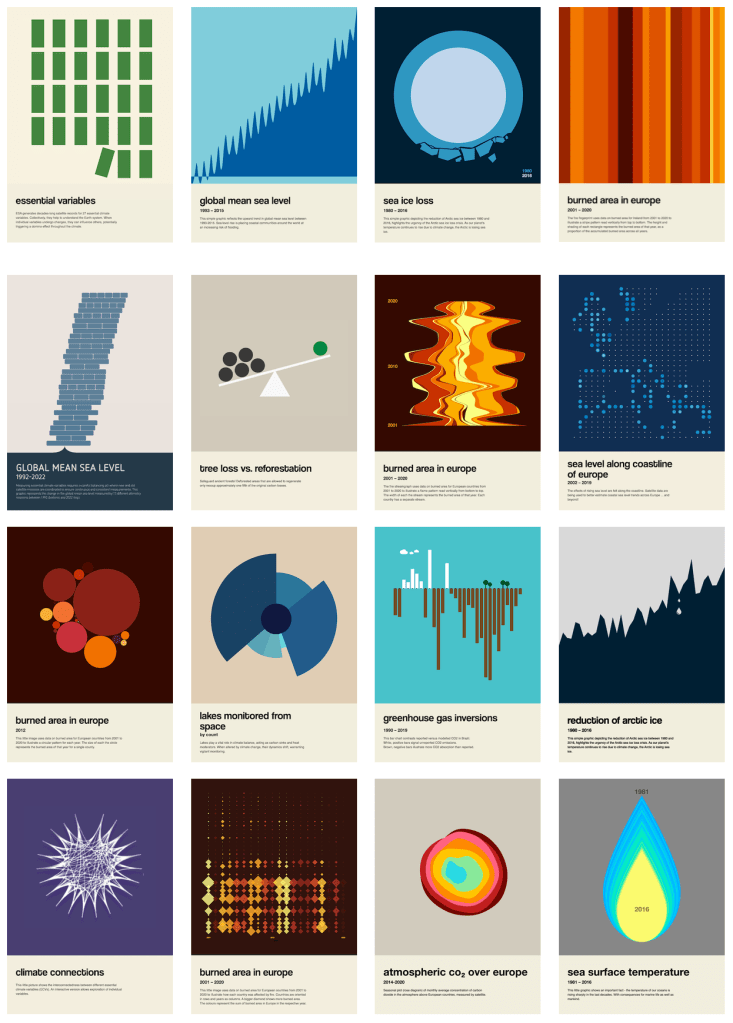
Hence why I have described this as a “more specific” competition since there is a clear niche style required even if there is a relatively open brief. The winning entry gets to travel to Italy, but chosen commended entries would be included in the gallery, to be shown online and at COP28. My entry is below.

This, to me, was an easy decision. The style of the entries is definitely “niche” but is absolutely right up my street in terms of personal style and preference: minimalist, geometric and colourful (with a climate message to boot). Now this will certainly not appeal to everyone, since it is not favouring complexity, interactivity, or analytics (and I won’t even mention storytelling!), but I had no hesitation in giving it a try. I created two such pictures, and chose the entry above for the competition, which I was pretty pleased with. Competitions like this are a hard recommend if they meet your own aesthetics and preferences. If they don’t – by all means give them a miss, as there will be other competitions out there that better fit your style (and which I haven’t featured here, because they don’t fit mine!)
3. Industry awards
Continuing our look at data visualisation competitions, we look at the industry awards, namely the Information is Beautiful awards. Prior to COVID, these have been hosted by Information is Beautiful, but are now organised and hosted by the Data Visualisation Society.
This represents a different kind of competition for the simple reason that it recognises and rewards previously published and created work. In other words, a submission to the IIB awards is not an investment in time and energy, because your entry will be work you have already created.
With this in mind, again it’s an easy decision. If you have created something you are proud of, whether as a hobbyist, professional, freelancer or anything else, then why not submit?
This award is a celebration of the best stuff in the industry and I can see no downside of being part of it, especially if you have a particularly good piece of work you are proud of that could make the Long List, or better still the Short List and beyond. And consequently, any work featured becomes part of an industry showcase. Here’s just a snippet of the showcase of 2003 overall winners:

https://www.informationisbeautifulawards.com/showcase?award=2023&type=awards
I have a good personal reason as to why I haven’t submitted for the last three annual awards, and that’s because I have been honoured and privileged to be a judge on each occasion. A big thank you both to Information is Beautiful and Data Visualization Society for the opportunity. I can’t begin to describe the volume of highly inspirational pieces of work it has given me the chance to enjoy and investigate.
But prior to the last three years of judging, I’m delighted that my own Minimalist Collection is a shortlisted entry from 2018, proof indeed that all types and genres of visualisation are celebrated!
4. Mass participation informal competition
We complete the list of competitions with a genre that’s not really a competition, but a community call for mass participation. Tableau’s latest community initiative uses the hashtag #dataplusmovies – it’s an initiative that’s still open now, with details to be found here:
With no winners, no criteria (other than to use the large supplied dataset), no deadline and no pressure, again I would say this is a no-brainer (with apologies that this is a Tableau-specific initiative). But other non-tool-specific initiatives exist that are great opportunities for fun and community participation, such as #30DayMapChallenge running through November, and #genuary2024 running through this month – a challenge that in previous years has led me to visualise using generative methods such as Truchet Tiles.
I always encourage participation in such initiatives, while at the same time making it clear that nobody should feel compelled to participate in everything that comes along. I have been meaning to enter a #dataplusmovies visualisation for quite a while, but for now, I admit I haven’t got round to it, and have nothing. I’m happy to commit to writing here though, that I will come up with something in the next few weeks!
But for now I showcase two entries that are very much to my taste that have inspired me to (eventually) participate
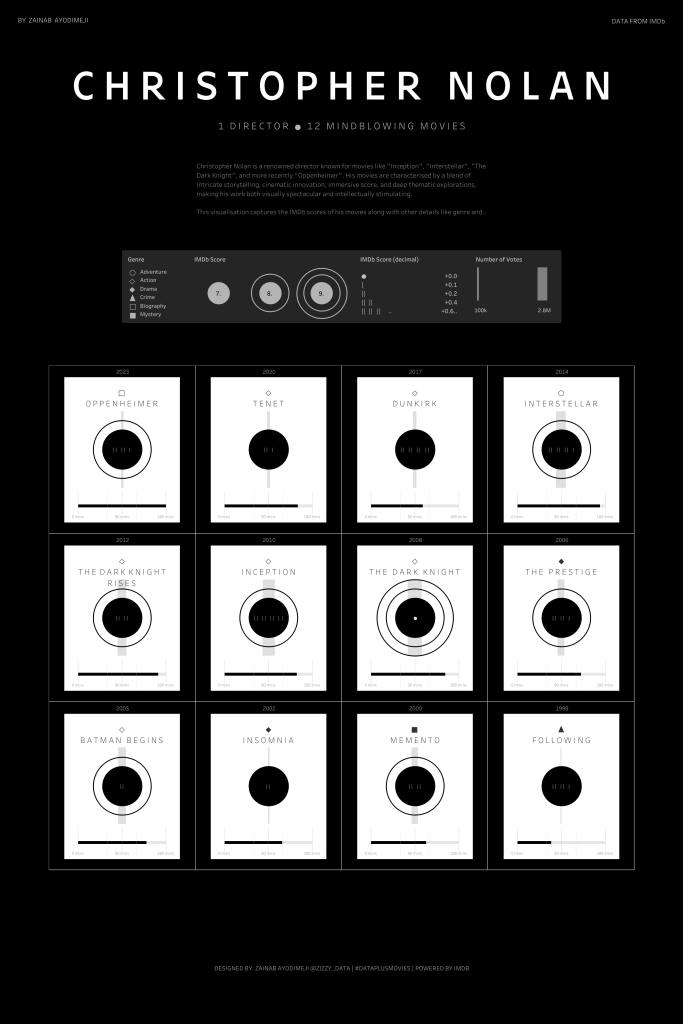
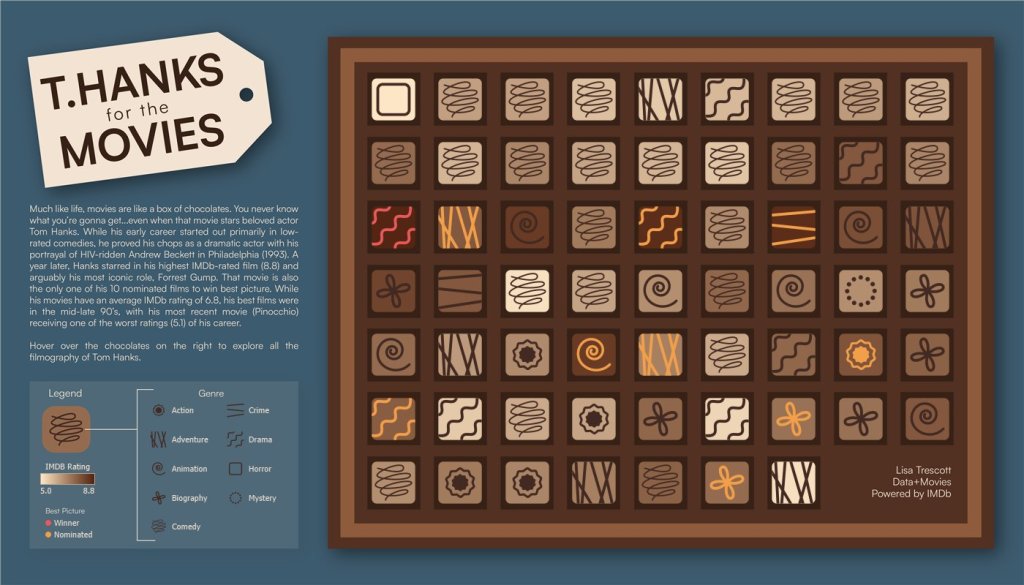
Thankfully, this is not a competition in the sense that there are no winners – if there were, I have two very hard acts to follow in Zainab and Lisa’s entries. There’s a whole gallery of further entries to be seen here:
When the opportunity of a competition arises, formal or otherwise, it’s important as a professional to consider the pros and cons in terms of your own time investment and the sharing of your intellectual property. But for an enthusiast, very often they are a prompt to try something new or interesting, with a source of data and/or a suggested direction to take: a source of challenge and inspiration. Give it a go!
EDIT:
Although this post was largely written last year and refers to competitions in and around October and November 2023 (excepting a late mention of genuary2024 added today), it was important to me not to post until this year. As I write and publish on 11.1.24, I am confident that the judging process for Iron Viz has finished, and my writings and opinions on storytelling and the merits or otherwise of my own entry will not influence my results in any way.
The delay does mean one thing though – I’m delighted that my Little Picture was highly commended and included in the Little Pictures gallery as a competition runner-up, to be displayed at COP28! Another reason to enter competitions – you don’t enter to win, but if you do win, place, or gain recognition, it’s validation for your skill and a feather in your cap to be proud of!
 Questions in Dataviz
